Samhain – Yule ce 2009 Vol.8, No. 1

An “Official” Publication of the Reformed Druids

Samhain – Yule ce 2009
Vol.8, No. 1
Calan Gaiaf – Alban Arthuan YGR 04

druidsegg.reformed-druids.org


Message from the Editor
& Senior Archdruid

Happy Celtic New Year to my fellow Druids and Waterkin!

This past season brought with it some gifts, but also lots of chaos
and challenges for growth. And now there is a definite chill in
the air, even here in Northern California, as the Winter season
is soon upon us…

During the past few months, the Mother Grove lost a couple of members – one moved to San Diego to be with family and find a job more suited to her graduate degrees…and the other one is having family issues and needs to focus on those at this time…

Just this past week, however, we met a like-minded person who just
moved down here from Portland, OR, and will possibly become a
new member of the MG. We also have two other people to meet and
check out, who have written to us and expressed an interest in
meeting us and finding out how we practice Druidism – so we’ll
see what happens… 🙂

Change is in the air, and I guess we’d better get used to it! According
to some wise and tuned-in folks, the changes are just going to
accelerate, the closer we get to the Winter Solstice of 2012.
There are a lot of old, outworn forms that still need to be torn
down, so that more appropriate and life-affirming forms can take
their place. We need to stay grounded and centered during the
chaos – not always an easy feat, to be sure!

But that is why we have each other – we are not meant to go through
all this alone! According to what I’ve been reading, the time
for being “solitary” is seemingly drawing to a close.
It’s getting harder to manifest on one’s own, and there is definitely
a renewed desire to form small communities of like-minded people
– or of finding one’s “spiritual family”…

So it’s at times like these that I feel much gratitude for what we
are building together – a web of Groves and Waterkin – interconnecting
all around Gaia. We have some wonderfully talented and caring
people amongst us, and I would like to see us continue to support
each other through all the upcoming changes – and continue to
grow and evolve as a Gaian Druid family!

Winter blessings,
In Gaia,
*Ceridwen Seren-Ddaear /|\
Senior Archdruid of RDG

*In real life: Karyn Arseneau

Growing Closer

by OMS Patriarch
Sybok Pendderwydd

I recently wrote this on our new YABB forum:

… But “back in the day,” when we were visualizing what the OMS (and so yes, none of this even remotely applies to what we have today, with the RDG and all) would look like in the future, we saw Groves of 12 or more individuals from every class, race, ethnic background, etc., led by a ruling collective; a “Nest” (like in SiaSL) of 3 or more united in polyfideletous
marriage, with the idea that these could eventually morph into “line marriages” (see Heinlein’s, The Moon Is A Harsh Mistress) involving the entire Grove.

It’s still how I would like to see the Mother Grove develop, although as I age I fear the likelihood of this vision is becoming dimmer and dimmer. <sigh>

Two people have read it. No one has commented. I’m not really expecting anyone to.

Ceridwen and I have sought a “third” for years now. We came really close once, but the candidate in question (let’s call her “J”) wasn’t truly polyamorous, and was much more interested in me than in Ceridwen. In fact, J plotted ways to break Ceridwen and I up (an impossibility – Ceridwen
and I are true soul-mates, and it is increasingly becoming clear we may be one soul within two physical bodies – but I digress).

One problem is that where we live isn’t as liberal/progressive as it seems it is from the outside. Politically this is definitely a “blue” County, and left-wing politics abound. But a progressive living style isn’t apparent, and we have found that even Pagans are skittish when it comes to discussion of polyamory or of naturism. We’ve lost friends over this, and we’ve even been accused of being “sexual predators.” One young couple whom we were friends with, ceased being friends when we decided to give them Raven Kaldera’s book, Pagan Polyamory as a present for his birthday. It was chosen as a gift because these young people had always made an open show of their sexuality, and Ceridwen and I thought this would be an appropriate gift. What happened was that somehow the gift was interpreted as a “come on;” that we were trying to recruit the couple. Well yeah we were, but as Druids, not as lovers.

This couple talked with another couple who were members of the mother
grove — also not candidates for our family, but certainly valued members of the grove – and soon the male member of that couple was forbidden to associate with us by his spouse, and we were “banished” from their home.

I can’t imagine how an open knowledge of “we’re looking for a wife” becomes a pronouncement of “we want to frak everything that moves” but there it is.

I suppose it is true that there are many people who might have become
members of the Order of the Mithril Star if it were not for our promotion of polyfidelity and naturism. On the other hand, given that promotion; there are very few members of Order of the Mithril Star that actually practice either lifestyle, let alone both of them.

I know of several members of the Order that are polyamorous, but in most cases, none of their partners are Druids. There are also many members who are naturists, but the other naturists they hang with are not Druids.

Our annual Druid Gatherings here have been well attended, and officially,
they are “clothing optional,” but as yet no one has, even for a few minutes in their own campsite, ever appeared nude, even though their have been times when it was warm enough. It may be one of those things where if one person were to matter-of-factly be naked, others would as well, but in these instances it takes at least one. Even I do this.

Another Pagan lifestyle choice we promote is that of the “Intentional community.” I don’t know any “mithrils” who practice this, aside from some (like Ceridwen and I) who have room mates. Our room mates are not Druids, they’re not naturists, and they’re not polyamorous. They’re not even Pagan, though they are progressives for the most part.

Having “house mates” is not the same as living communally. In fact if anything, it is quite constraining. We only have them because it is an economic necessity; the rents in Humboldt being so high that almost everyone has at least one house mate. You can’t legally advertise for Pagan, naturist, polyamorous house mates. Nor is it practical, as it limits the pool you are searching in. It’s hard enough to screen out people who are politically incompatible, let alone totally spiritually compatible.

Then there is the vision of Dryad’s Realm, our dream of an intentional Druid community in the redwoods here, that would be host to a new age / naturist resort. There has been very little expressed interest amongst mithrils.

Then there’s the issue of “class.”

Pagans are as much products of society as anyone else. Wealthy Pagans
don’t want to hang with working class Pagans. Middle class Pagans prefer to hang with wealthier Pagans than with working class Pagans. It’s also my observation that the lower down the class scale one is, the less likely they are to go for alternative life style choices, even choices that would ultimately, and in the long run, be economically more beneficial and preferable for them (like intentional community).

My other observation is that wealthy Pagans and working class Pagans
tend to be in the closet about their spirituality (the wealthy out of fear of losing their non-Pagan friends; the working class out of fear of losing homes or jobs). It’s the middle income Pagans that tend to be out front, and they are also the ones who go to the Pagan festivals and are also more likely to be naturists at home (and at festivals) and to be polyamorous. This makes sense since festivals cost money, and the best places to practice naturism
are naturist resorts, which also cost money, and those activities are engaged in by people who have disposable resources. Those of course are not the only activities that Pagans like to engage in. Putting on and attending Renaissance Faires is popular, and also very expensive, and again, one engaged in by the middle and wealthy Pagan classes.

What does all this have to do with the Order of the Mithril Star? Well,
honestly, most of our members are living within 300% of the Federal
Poverty guidelines. I’d say at least 1/2. People in that bracket are usually a lot more concerned with survival issues than they are with getting to practice naturism or polyamory. People in that bracket are also way less likely to be politically active at all (they may hope for health care reform, but do little or nothing to help bring it about, because they’re totally focused on survival – even though healthcare reform promises to help their survival). Add to that the stigma of living in that bracket (because our society makes you out to be a “loser”) and you tend to live life under the radar.

I think most of our members might want to be able to walk around the apartment, or maybe even the garden, nude. But they don’t. They might wish they had a 3rd (or even a 4th or 5th) but never bring it up or pursue it. BUT, they did join OMS, so that means that they are at least thinking, maybe dreaming about those kinds of life styles.

How do we collectively translate the dream into reality?

May the FOREST be with you always,
And may you never thirst for the waters of life.

Druid *Sybok Pendderwydd, Patriarch
Order of the Mithril Star

*In real life: Ellis Arseneau

Read more from Sybok on his blog: http://redwoodcoastviews.blogspot.com/

The Earth Spoke

Generously contributed by
OMS/RDG Druid Phagos

The earth
spoke,
As an oracle
In a language
Known only
To the stars
And the wind

It spoke,
And the animals listened,
It sang,
And the trees whispered along,
It dreamed,
And the stones just waited
It watched,
And the sky turned,
From pink to blue to red
It sighed,
And the wind rushed from
One end of the Earth
To the next
In obeisance
It thought,
And the stars twinkled above

The animals
paused,
Ears cocked,
Eyes trained on the source of the sound;

The trees
mimicked,
Each leaf,
Each branch
Repeated the call;
The stones breathed slowly,
Waiting for their next prompt
To motion;
The sky glowed,
With a message,
Encoded in hues;
The wind heard and understood,
Pondered the oracle,
And went on its way;
The stars saw the message as light,
And the responded in kind

And such is the Way:
The earth speaks,
The wind listens,
The stars shine,

The natural
order feels,
And man continues on,
Unknowing

©The Ogmic Press
All Rights Reserved

Samhain Meditation 2009

Generously contributed by
Jackie Greer of the Clan of the Triple Horses

The trees are a riot of color in Southern Oregon. The Earth’s
Mother’s cloak rivals Joseph’s Biblical coat with
reds and yellows and oranges beyond words to describe.

My eyes fill with tears at Her glory. I am desperate to hold onto
it another moment, another day, another week, but the colors
will pass too soon into nothing but photos. I stare, saturating
my mind and heart with color against the days that will come
too soon when I will see nothing but grey and bare branches
and ache for color and light.

As Earth Mother pours the last of Her heart’s blood into
Her Sacred trees, so I am pouring the last of my energy into
completing the projects I began during the Season of Growth.
Will I ever complete them? The urgency to complete, to conclude,
exhausts me, but the colors revive me and I can go on one more
day.

The Ancestors draw near, calling from the other side of the Veil
with ever-growing clarity, and the chorus of their voices adds
to the cacophony until my heart and mind are ready to burst.

The season of rest cannot come soon enough for any of us who bridge
the worlds—between mundane work and sacred solitary moments,
between our beloved Ancestors and our current family, between
household chores and time at our altars with the Shining Ones.

Samhain’s message, the message of the Celtic New Year, is that it’s
time to let go. It’s time to offer this year, what we
manifested, what we failed to manifest, its joys, tears, births,
deaths, in sacrifice to our patron Deities, to be stored in
the Akashic Records and in our hearts and memories. Whether
it was “good” or “bad,” clinging to it would leave no room for
the newborn Sun King whose Light will spark the Sun again
in just a few weeks.

With that done we can enter the rest we crave in the Earth Mother’s
womb. Only in Her depths can we renew ourselves and be ready
to grow again with the newborn Sun. We leave work behind and
within ourselves we find our souls again.

This Samhain, I thought it appropriate to make a few resolutions
as my last act before “retiring” for the season
of darkness. Why not? It is the New Year after all!

I resolve to find moments, even if they are literally moments,
to meet the Shining Ones outdoors, on a walk, even by just stepping
out into my yard with an offering.

I resolve to seek guidance daily from those on the other side
of the Veil who yearn to walk my path with me, illuminate its
pitfalls with their wisdom and hold me up when I don’t
feel I can take another step.

I resolve to cherish those on this side of the Veil, to put work
aside to spend precious time with them while I can still laugh
with them, cry with them, hug them, or just look at them. I
resolve to let them know I care.


With my Boxer Familiar Mosely, I resolve to strengthen our psychic
bond. He has so much to say and so often I’m too distracted
to listen.

I resolve to care for my body, to give it the rest it needs, the
exercise it needs and the food it needs.

Even more I resolve to care for my soul and to take time to listen to my heart, shutting out the world’s clamor for
even a few brief moments every day.

I resolve to fall on my knees daily in gratitude to the Shining
Ones for all they have given me!

The Morrigan’s Prophecy

Macha

Peace
to (as high as) the sky
sky to the earth
earth beneath sky
strength in everyone
a cup very full
a fullness of honey
honour enough
summer in winter
spear supported by shield
shields supported by forts
forts fierce eager for battle
“sod” (fleece) from sheep
woods grown with antler-tips (full of stags)
forever destructions have departed
mast (nuts) on trees


a branch drooping-down
drooping from growth
wealth for a son
a son very learned
neck of bull (in yoke)
a bull from a song
knots in woods (i.e. scrap-wood)
wood for a fire
fire as wanted
palisades new and bright
salmon their victory
the Boyne (i.e. Newgrange) their hostel
hostel with an excellence of length (size)
blue (new) growth after spring
(in) autumn horses increase
the land held secure
land recounted with excellence of word
Be might to the eternal much excellent woods
peace to (as high as the) sky
be (this) nine times eternal

~~ Source Unknown ~~

About Scrying

The word ‘scry’ comes from the word ‘descry,’ meaning to see or
perceive. Mirror gazing, or scrying, is one of the oldest known
forms of divination, dating back to antiquity. The famed prognosticator
Nostradamus used a form of scrying to make his famous predictions,
employing a dish filled with ink as his method. Yezidi mystics
use a concave, polished bowl. Mormon prophet Joseph Smith contacted
angels using a ‘seer stone.’

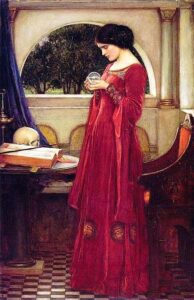
The infamous magician John Dee and his partner Edward Kelley used
an obsidian crystal in their experiments, and we get the popular
conception of a ‘crystal ball’ from the popularization of their
methods.

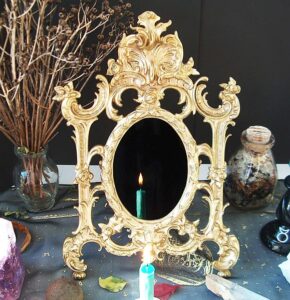
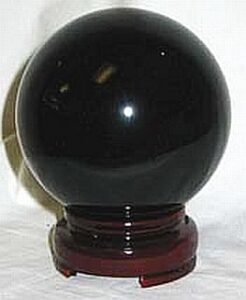
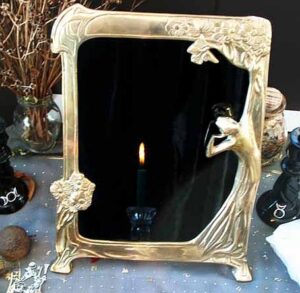
There are almost endless surfaces suitable for scrying use. Mirrors and crystals are the most popular, but any item that provides a deep, reflective surface will do: water in a shallow dish, ink, a dark crystal – even a darkened television set!

One traditional belief about scrying is that it allows access to
the Astral world, and makes communication with its inhabitants
possible. Others believe that scrying produces a trance-like
state, in which the scryer has easy access to his or her subconscious.
Neither of these truly explains the experience of the ‘Astral,’
although there is a belief in some circles that the apparitions,
angels, and other beings encountered are manifestations of the
super conscious – messengers from one’s own higher self.


Constructing a scrying mirror


As I mentioned earlier, there are several acceptable scrying
tools. It is not important to follow any of the usual (and often
quite silly) requirements. You do not need a ‘pure’ crystal
or a ‘charged’ mirror. There are rationales supporting various
methods, the purpose of which is usually to get the potential
seer to put a certain degree of effort into the proceeding –
but none of these is an absolute. All you need is an object
that provides a dark, reflective surface, patience, and a comfortable
place to sit. The most inexpensive to create is the black mirror,
and there are several simple methods which can be used to create
one.


Getting started


Purchase a large, inexpensive picture frame with a glass insert
(of course, you can choose any frame that catches your fancy),
and a can of flat black spray paint. Believe it or not, both
items can be had from a large discount store for about five
dollars all together. Next, remove the glass from the frame
and clean it with window cleaner- make sure to wipe off any
lint or dust particles. Spray a light coat of paint over the
glass and let it dry completely. Repeat with several more coats
of paint, until no light shows through when the glass is held
up to the light. When it is completely dry, simply replace the
glass in the frame, with the painted surface on the inside.

Another method is to ask a glasscutter to make you a circle of glass
(be sure to have the edges sanded). Paint it as described above,
and then glue a piece of felt over the paint (be sure to use
white glue or another non-solvent glue to prevent marring the
painted surface).

Learning to scry


Scrying is not a hobby for the impatient. It takes a lot of
practice, so don’t get discouraged if you don’t get immediate
results. The first task is to create your space. You’ll want
a block of time without interruption, a room that can be darkened,
and a place you can sit comfortably for long periods. You’ll
need a comfortable chair, preferably with a back on it, or a
wall to sit against. You’ll want to position your mirror (or
whatever object you’ve chosen) at a comfortable angle; place
it so that it does not reflect objects in the room. You need
to have very little light – a small candle, a night-light,
etc. A flickering candle creates a strobing effect that you
might find useful or distracting, so experiment a little to
discover your preferences. (If you are using candles or incense,
I strongly recommend that you use a timer or alarm clock, in
case you fall asleep)


Next, create a consecrated space, using whatever method you
prefer – smudging, a banishing ritual, casting a circle,
etc. This helps to create a sense of protection, and to focus
awareness on the task at hand.

I would discourage the use of music, incense, et al., until you
are comfortable with this technique. Both can be useful, but
for now, they are more likely to create a distraction.

Relaxation is essential – the more relaxed you are, the more likely you are to have success. Take a warm bath or a hot tub before beginning, or use a progressive relaxation technique – breathing, or whatever method you’re most comfortable with – to achieve a state of relaxed awareness. This takespractice as well, so you might want to work on this for a few days before you go any further.

With that accomplished, sit comfortably. Breathe deeply and slowly, and let your eyes go slightly out of focus while gazing at the mirror. Concentrate on your breathing – not on the mirror. Keep your gaze relaxed; it’s okay to blink.

Concentrate only on your breathing. If thoughts or fantasies intrude, don’t
worry – just dismiss them and go back to your breathing.


Eventually, you may begin to see what appear to be sparks of
light, or a ‘foggy’ effect. Don’t concentrate on these phenomena
– just remain relaxed, and allow them to develop. At some
point, the images will become stronger – you may see pictures,
shadows, or lights and colors.

The ability to “see”

This is a very important exercise to master if you are new to scrying
or are having trouble receiving images. It will aid your “visual
imagination,” which allows your psychic and physical eyes
to see clearly together. It gives clairvoyant strength.

Sit before your mirror and begin to imagine objects on its surface,
one after another. You should try to see these images clearly
in the mirror with your eyes open, just as if they were there
in reality. Try simple shapes or colors first. Hold onto the
image of each shape, object or color one minute before dissolving
it and going on to the next. For example, use a red triangle,
a yellow square, a blue circle and silver crescent; see them
appear in the mirror using your firm imagination. For best results,
do this exercise every day for 15 minutes until it is mastered.

This exercise is well worth the effort; it gives magickal discipline
and strengthens the inner eye so visions can come with clarity
and ease.

Consider the reality of the Akashic records, in which all ideas, actions,
influences and vibrations are stored. With practice, you can
develop the ability to “read” these records and focus
on this vast source of timeless knowledge with the aid of the
mirror and a strongly directed imagination. Guides from the
world of spirit often lead the scryer in astral travel and mental
journeying through the black mirror or crystal sphere. Scrying
develops one’s clairvoyant abilities and is especially helpful
in strengthening the third eye.

Remember that the inner eye sees inside the mind, through the magickal
imagination. Most people when scrying do not see the images
appear with the physical eyes on the mirror’s surface but see
within the mirror and in the mind’s eye. The mirror acts as
a focal point, a gateway within.

Other ways in which the black mirror can be used

To contact spirit guides
To access knowledge
For healing and self improvement
As a magickal transmitter and receiver
For divining the past, present and future
As a portal to the astral plane
For shamanic journeying
For ritual invocation and evocation
To improve visualization skills
Preparing to work with the black scrying mirror

Always keep the surface very clean using alcohol and a soft cloth.
Never use it for anything but its intended magickal purpose.

Continue for as long as you are comfortable. When you begin to feel restless, it’s probably a good time to stop.


Recordkeeping


Don’t worry if what you see makes no sense at first. After a
session, write down your impressions, and make a note of your
general state of mind. It is also a good idea to keep a record
of any dreams that occur after a session – in fact, it
is a good idea to record all of your dreams, as this will strengthen
the lines of communication.

Incense for psychic work

The best incense to use when working with the mirror or any scrying
device is lunar or psychic in nature, representing the sphere
of Yesod. These types of blends may be purchased or created
by yourself and must be burned on self-igniting charcoal disks.

Here are some excellent recipes for fine-quality magickal incense
to be used for the rites of scrying.

Lunar blend incense

A base of white sandalwood powder
Orris root and myrrh in equal parts
Oil of jasmine and jasmine flowers
Oil of lotus and synthetic ambergris
A small pinch of refined camphor
Poppy and cucumber seeds

Blend together sandalwood, myrrh, and orris root, and crush them together
into a powder. True refined camphor is hard to come by, but
if you should have some available, add a pinch to the powdered
base. Also add at this time the poppy and/or dried cucumber
seeds. Put this mixture aside in an airtight jar.

Next, blend the jasmine, ambergris and lotus oils together in equal
parts. Coat the dried jasmine flowers with the blended oil and
set them aside in an airtight jar.

Let these sit until the next full moon. On the evening of the full
moon, mix together (in a silver or crystal bowl if possible)
the oil-soaked flowers and the powder base with your hands,
meditating as you mix on the beauty and wisdom of Mother Moon.
Ask her to bless this incense with Her magick.

Scrying
incense (psychic blend)

A base of mastic gum, myrrh, galangal powder and frankincense

Mugwort and wormwood herbs
Rose petals and lavender buds
Green cardamom pods and star anise
Bay leaves
Oils of mimosa and lotus, and dark musk

Blend together mastic, myrrh, galangal and frankincense in equal parts
and grind to a powder base.

Add a few cardamom and star anise seeds to the base and put aside
in an airtight jar.

Now mix equal parts of ground mugwort, wormwood and bay, about half
the amount used in the powder base.

Coat this mixture with dark musk oil, and put it aside in a sealed jar.

Mix the lavender and rose petals together, coat them with mimosa
and lotus oil and put them aside in a sealed jar.

Let the ingredients stand for nine days during the waxing of the
moon.

Then blend all ingredients together by hand.

As you mix, meditate upon your spirit guide and developing your
psychic abilities. Know that when the incense is burned, your
inner eyes will open and a link will be formed between you and
world of spirit.

(It is best to remove anise and cardamom seeds from the incense
before burning; their scent will have been absorbed by the incense
base.)

Sources:
http://tinyurl.com/yala2qe
http://tinyurl.com/ye9lynf

For great scrying supplies, go here: http://avalonrisen.com/scrying.htm

Generously contributed by
OMS/RDG Druid Jeffrey T. Heyer

”Come back!”

Silent as a riptide it pulls me. Nine nights it has called me.

”Remember!”

Black is the portal looming ahead: a shaft dropped down to the secret heart of the earth. Up from the well like a wound in the world, the voice is calling, calling, calling:

”Return!”

Brief, dagger-sharp memories of places I have never been, transfix
me – standing stones cry out to me against a purple, star-pierced
sky. The cold of the altar stone years for my back. The old,
old love, the old, old terror stirs and flexes its claws.

Bright as a blade the vision flashes and I, grown to a man, awaken
to a grey, eerie dawn in a dead field, one crippled leg hobbled
to a stake. Mad-eyed wild-women dance round me, ivy in their
manes, their teeth shining like the fangs of wolves. My blood
is on their nails. Every one of them is calling me back.

”Let me go!” I cry, but greater than fear is a weird love for
these ghosts. I am bursting with passions I cannot understand.

I long for the weight of an iron torque about my neck and I feel
the wheat in the fields aching for me. A steel pommel calls
to my grasp and the grace of the fleet forest deer grips my
throat.

”I cannot bear it!”

I am ashamed to say it, even in a nightmare, but I do: ”I
am not a man!”

My heart has grown just large enough to hold the fruits of twelve
short summers.

The blackness of the portal hears, and gathers itself like an ebon
cloak about the greatest of the ghosts as he rises to
tower tree-tall before me. Titan hooves clack against the tunnel’s slab floor. Antlers spread like topmost boughs above, proudly upreared by a man-like form, its shoulders oak-bole broad, its black adorned with glints of gold, armed with the faint clatter of steel.

I reel. ”Please! There is no room in my heart for you!”

”Come back!” is the only reply; always, ”Come back!”

And I must.

Like the maw of a beast, the tunnel takes me. It is into the shaft
and down and then down and then deep, dark down I go. Until,
through the waving of the stag-horned hunter’s black draperies,
I glimpse the face of the one who calls. An arm’s length
before me, he appears. He reaches out to take me. He opens his
mouth to speak.

Lightning leaps through every nerve and with a spasmodic lurch, I wake,
shuddering. But the face of the caller is branded in my sight,
his raven scream is in my ears. His face is mine. Numbly, my
lips form words I do not understand: ”The Black Crow Calls.”


Seldom do our northern mists cool the courtiers of the Queen, for the borderlands are not a place the rich and high care to go. So I stood with all the rest, restless with hope.

They jingled by, the three rich riders, resplendent, self-satisfied and plump as burghers, ostentatiously bored amidst the excitement of the common folk and those of us of the provincial nobility. I felt betrayed. There was no greatness to them. Why had I been compelled to be here? My eyes scanned the assembled crowds restlessly, ignoring the passing train of the courtiers.

There she was.

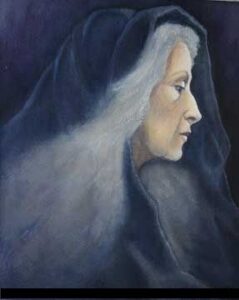
Standing with the others, an older woman with a strong, lined, thoughtful
face and wise eyes. Thick, silver-grey hair showed beneath the black shawl. Her dress, too, was black as the wing of a crow. And her eyes were not on the procession. They stared straight at me.

I knew her and had never seen her and my breast ached with the beating of my heart.

A little turning up of the lips enigmatically and her eyes met mine. I felt as if arrows pierced me through. The scream of a raven was in my ears.

She turned and began to push her way through the dense crowd, away
from the still passing procession, and that enigmatic smile of satisfaction was lost to my sight.

A wing of darkness brushed by before my eyes and something broke inside my head. Abruptly I was moving. With a strength beyond my years, I escaped the clutching hands of surprised, surrounding servants – then I was forcing my way through the thick knot of solid, stolid citizens. The last servant of the three lords passed in stately progress as I was across the mud street behind him before the crowd could close in at his back.

She stood in the distance ahead, waiting at the edge of town, looking back to see that I still followed and that my father’s men were lost in the press behind. She walked unhurriedly ahead of me and I followed. Away from town we went, round the edge of a wood, past fields of yellow grain.

At last I stood before a little house with a thatched roof reaching almost to the ground. Gasping in the coolness of the quiet end of afternoon, I hesitated.

Before me was an open door and the portal was dark. Within me was turmoil – leaping, twisting. I looked around at the empty fields. Where else was there to go?

Step by step I neared the portal and the dark oblong grew larger, but less dark. Then I stepped through. A cauldron, looking vast in its blackness, stood on three legs in the center of the room. Smoke rose round it, adding to the black of it’s sides eventually escaping
through a hole in the roof. She had only just gotten the fire going again, but she stirred the streamless stew gently, a slight smile on her
face – a face furrowed by the passing of age, yet ageless in itself.

”Who are you?” I asked from a dry throat, lunging like a baited hawk at the only food I had ever seen.

I knew myself bewitched, but there was no time for more than a single shiver to run up my back-bone. Quick, harsh, demanding, the words came from me, ”Why did I come? Why should I follow you?”

But she was silent as the ghosts that haunted me each night. She drew slow circles in the water and gazed into it as one gazes at a scene far away.

As my confusion increased, the demanding young noble crumbled quickly
and the unhappy child with a lump in his throat began to show through.

”What do they call you?” I asked simply.

For the first time, she spoke.

”Black Crow.”

I stood there helplessly, the hot tears burning to get out. All the rules of my world, so carefully clutched up out of chaos over the last twelve years could no longer protect me. All rules lay dead at the threshold of the Black Crow.
What was I supposed to do?

Looking from her simple gown of solid black, down to my own rich holiday
dress, it seemed to me that, like my striped jerkin, I was neither red nor yellow nor brown nor any one color or thing. Words came from deeper than the heart, from the very center of me.

”Who am I?”

Her eyes met mine again, and the words began to pour from me, ”Why
am I never at home in the place where I was born? Why do I hear someone calling me sometimes, and why does it hurt so much?”

I tried to say, ”In the Name of God,” but the words would not come out. Instead, I fell at her feet and clutched the thick, slick-worn cloth of her skirt.

”Please – who am I?”

”You are of the Blood,” she replied.

Her words went through me and I knew they were true, though I did not know what they meant. The tears began to escape despite my best efforts.

”Please,” I said, speaking without choosing my words and struggling to keep my voice steady, ”help me to understand. I am lost. Somewhere there must be a clan for me, but I wandered away and couldn’t find my way back. I was born to the wrong parents! Where are my people?”

”Thou hast been in the earth long, young one. Thou has been born and lived and died and rested and then been born again, many times.
For that is the true way of the world. Thou art of the blood of the Ancient Ones, priests and priestesses of the Mighty Ones of Earth and Sky.”

A provincial Christianity, brow-beaten and rod-beaten into me, battled desperately for control – pitted against forces far older and more deeply rooted in soul and heart.

”I will go to Hell and burn forever!” I cried, ”But I must know! The Ones that call, what do they want from me? I can’t hear their voices!”

The wise woman’s voice grew soft, yet the words bound me straiter than chains. ”The Old Ones would hear their names on thy lips again. It is for that they are calling. Thou did’st follow me because we are linked, thou and I. In our last lifetime we were lovers, Lady and Man. The old promises are not forgot.”

Gentle hands stroked the hair of a boy whose heart was filled with pain. He clung round her knees, crying for the loss of a love he had not remembered, even in dreams. Crying because now that he had found her again, age had cheated them of that promised love.

The crying ceased. Dim, uncertain memories of vows to the Old Ones of the World danced like shadows before his mind’s eye.

“I think,” said I, ”that I swore to be Theirs always, and that They have taken me as a sacrifice, time and time again, never letting me grow old. Black Crow, is it my death they want this time, or is it my life?”

I looked up, and there like the moon above me was her face with that enigmatic, now frightening smile.

”Is it one and then the other?” I asked, ”And me not knowing when the axe will fall?”

Still she smiled and there was no answer. She was thinking of her  own end.

A curious quiet came over me. Like when the sky is still filled with clouds, but has grown too weary to storm. The wise woman raised me and set me to stirring the cauldron for her. She brought in herbs from her garden.

”This is my home,” I thought, ”not the manor house of a father whose face I cannot remember when I close my eyes. I have come home.”

At last I asked the question: ”What shall I do now, Black Crow? I want to stay here with you, but my father’s people will
come looking for me.”

She nodded.

”I must go back, mustn’t I?” I said sadly.

”Aye. Thou shalt learn to be a noble, Thomas. Because our people were conquered long ago, and the Houses of our leaders thrown down, we have had to hide in the shadows. When it came time for thee to be reborn, thou did’st choose to leave the blood-lines of thy clan to be born into the house of a lord of our conqueror’s race.

Learn to use a lord’s power to help our people, Thomas. Thou may’st visit me and I will teach thee and show thee the kin of thy soul.”

”But we must be careful, Black Crow,” I remember saying. ”No one must know I come to the house of a commoner. They would suspect.”

The Black Crow’s eyes turned down to where the evening breeze, blowing through the open door and past my small, tense form, stirred steam into white, elusive wraiths. Below, the fire crackled and wood popped. Her countenance was lit from within like the glass hood of a lamp aglow with candleshine. Now darkness beat like wings fluttering round her candle, casting shadows from within upon her face.

I saw all this, but I did not then understand.

”We must be careful,” I said, and left.


Next comes a memory locked in the flesh, not the eyes or brain. Years had passed in learning from the Black Crow, during which I had made of myself a sober youth, given to dark and simple dress. To my amusement and, thought it meant safety, chagrin, this sometimes led people to suspect me of puritan leanings.
The beauty and wonder we shared is lost. This one night seared those
years away:

Hands, holding me back. A man wrapped round each leg and uncounted
hands clutching tightly to either arm and all about my chest, as I strained vainly forward.

How many there were, I could not tell, nor who there were, for they all wore hoods or scarves or masks. But from the moment I rounded the bend where the path curves about the edge of the wood, and they came springing out of the darkness upon me, I had no chance. I would not keep my avowed appointment.

”How dare you!” I raged, trying to fling my body forward and loosen their grasp. ”Who dares set a hand upon his Lord? What do ye mean here?”

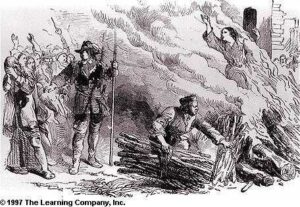
The men all kept silent, lest I recognize their voices, but with a sudden cold sinking of the heart, I knew – I could smell the smoke.

The quiet young nobleman who had thought himself able to hide his heart forever from all around him gave an unrestrained howl of horror.

”There is not a man among you dares stand face to face with me!” I cried desperately. ”Ah, give me my sword and I’ll dare the best of ye or all of ye at once! But let me die with a sword in my hand!”

They held me tight, being no fools, and the sword I had trained with for so long hung impotent at my side, the hand that hungered for the feel of the hilt, stretched out helpless above.

Eight years of careful silence would not leave me and I could not even call out to my Gods.

”Think ye that I do not know ye all?” I asked the faceless men. ”You are surely my own men, tenants of my land which I have kept for you and blessed for you. Have not the harvests been good all the years of my lordship? Have I not served ye better than the Lord my father who taxed and burthened ye all?”

Silently they held me, their yeoman hands firm yet gentle. My name was
not among those the White Lady called that night.

The words were ripped up through my guts, one by one, like fishing
barbs on a string. ”I think ye mean to burn my friends!”

With a furious energy, I fought to burst the bonds of death, but my loyal tenants had determined to serve their master in the best way they knew how. Surely if they burned those who had bewitched me, I would be free again. Free? Through a long lifetime after, I would suddenly feel those
imprisoning hands about me and find myself back once more to that terrible night. Longer than the lifetime of the flesh that felt them, their palpable memory lasts.

”Is this love?” I cried, choking, ”to hold me here while you destroy everyone I love, everything I live for? You fools, I am not bewitched! You cannot save your Lord from the pact he’s made! Can’t you feel it? It’s me you’re
burning out there!”

The furious struggle ceased and I stood still and trembling in their hands. Savagely, I struck at them with the only thing I had
left – the voice of my hatred.

”When the fire dies, so will I, and you shall hold naught but ashes in your hands. But know ye this: that the spirit of the land lives in me, your Lord, and I give ye all my curse!”

Dread put its eagle talons in them then, for Christian though they were, in their hearts they knew the Lord is married to his Land. That was why I lived to hear the screams of my clan-sisters and the brothers of my blood.

”The Land shall lie barren,” I called in a hoarse, distorted voice. ”Your crops and the beasts of your fields shall sicken and wither. No man shall dwell in this desolate place; the beasts of the wild wood and the seeds of tree and shrub shall shun this land that hates the living! Where now are your farms, ’til the end of time, shall be naught but wasteland and death!”

Then I hung limp in their hands, the soul gone out of me.

One man of them all had the courage to throw off his scarf and show his face to the Lord he had betrayed. Numbly I looked in that face and saw a farmer, a man of earthly possessions, solid life, father of sons and daughters; bearer of a conscience. And I saw and remembered the look in his eyes. It was a look of utter pity.

Dimly I was aware of them bearing my spiritless body back to the kinless
castle where the years had left none to await me. There they laid me on my bed, as gently as they would have laid corpse in coffin.


”How dramatic!”

Sitting alone – as always – at table, I drank my wine, looked back on these events of twenty winters gone and more, and smiled
my twisted, cynical smile. I had not died. That is, I had not wholly died.

”Where are you now, Lord Thomas Magus,” I asked, ”Kabbalist, student of manuscripts in Hebrew, Latin and Greek?”

I smiled that inane, sardonic smile and poured more wine down my throat. Not all the wine in my cellars could fill my gulf. Not all the hoarded wisdom of the ages could still the echoes in that vasty wasteland.

If quiet I had been before, companionless was I now. Better was I pleased by the converse of spirits than by that of men.

Mockery.

To a shuttered window I moved, to peer through the cracks, but there was nothing outside. Dark of the Moon. These last years I seldom left the manor and my studies anyway.

”There is worse than the stake, my friends,” I whispered, ”there is being buried alive.”

Turning from the shut-up window, I crossed an echoing, stone-flagged
plain to where my statues stood. How many
nights before had I sought companionship here? My eyes ran their accustomed track along the old familiar curves. The designs were classical enough to be safe, but with hints that these represented more than what the Christians now mostly saw as storybook Gods and Goddesses, less dangerous than the Fairies of the nearby fields.

The silence was like a weight. I stood at the marble feet of Selene
and gazed up at the cold, impassive face.

”I studied the wonders of the living world,” I whispered, ”and in the end I found mass-murder. I turned to the ways of temporal power, and with other arts, wrought sterile vengeance. I’ve sought to build a pure realm of my own thoughts, my experiments, my spirits. I have built a tomb, Selene, a trap,
a lie. Dear Goddess, I am empty. Guide me.”

Mockery.
Tonight Selene had no glow of life, Silvanus did not seem to subtly shift his alabaster limbs. Tonight Aphrodite, Dionysus, Hera – every figure in the hall mocked me with stillness. There were no Great Ones here. Tonight I was surrounded by statues, stone dead.

The sound of wine refilling my goblet warned me belatedly that a servant had entered the room. I spun about and stared closely at him. He gave no sign of having overheard anything. But that is the way of servants.

How could I be so careless? Then I hesitated, torn. Here was, after all, a human being to whom I might speak. And say what? Human he was, fellow he was not. Not for nothing had I staffed my house with servants who never spoke in my presence. And better it pleased me if I could hire the deaf.

I gave him the wave which meant, ”Leaver the wine, and leave the chamber for tonight.”

In his wake, silence – deafening, appalling– clanged shut like a prison door.

I turned to the darkened mirror on the mantlepiece, which I usedfor confuring spirit guides. My own voice sounded ghostly in this empty place, but desperate for dialogue, I spoke to my shadowy reflection.

”Thou foolish man. Thy greying hairs are an outward sign of the thousand little infirmities which have begun to cling to thee. Their sum is age.”

The face in the glass seemed to alter, as if another face were shiftingly superimposed over my own, and thoughts formed unbidden in my brain: ”You have no heir to take your place as Lord of the Land.”

”Why should I care now?” I asked defiantly. The Land is on her own – I no longer aid her. I’m tired of vengeance – I no longer blight her either. It has been years since I gave a damn about her.”

I slammed my fist upon the mantlepiece and made the mirror jump. ”The Lord and his Land are one flesh. In cursing her, I have brought barrenness upon myself. What is all this knowledgefor? Who shall read the books of power I have so meticulously penned?

”A younger man, knowing what I know, unfettered by a heart of ash – what might he not accomplish? There need be no common connections this time to make people suspect. The heir to my power could be of high enough standing that I might legally deed him my title and land.”

The reflection of my features grew ugly and I turned away. ”What am I thinking? The one thing I’ve learned is to trust nothing and no one.”

If I should allow myself to feel again…

”I never knew,” I said in a thick voice, ”was it act
or word of mine which brought my friends to the stake?”

There came no answer. I ran a hand over my face and leaned my forehead on the mantlepiece, seeking to ease the conflict. ”The times are more dangerous than ever,” I reasoned. ”This
new king, James, is spreading a mindless fear of witchcraft. There are many who believe me to be just what I am and who keep silent only from fear of my arts, both magical and politic. Have I the right to risk another?

”Have I the courage to risk another’s loss?”

”What does it matter what thou think’st” said the ghost in the glass. ”Thou hast heard the crow call.

So I began to appear occasionally at court and to visit my peers.
Behind a wry smile, I learned again to make meaningless conversation,
while unremarked, I viewed and considered the youth of the nobility
– meaning to stake my all on one last throw.


Time is a strange God. He turneth the musings of a grey-haired man into the fevered memories of a man whose hair is white as the sheets of the great cold bed where he lies, a harsh-lined face wedged among snow-capped pillow peaks.

Brain and body burning, then freezing, only to burn again; though fever-visions haunt me, my mind is sharp enough to know my state.

The crows are croaking at me from the roof. My lungs are filling with liquid – pneumonia.

Why can I find no gentle acceptance of death? Ah, must cough and gasp. Hard to breathe. I never thought I’d live so long, nor surely, grow so old.

”Ah,” I gasp, ”where is the boy? Where is Roland, my apprentice,my heir? He should be with me.”

My voice is too weak to penetrate the heavy air. There are no servants to hear, in any case – he has sent them all away, ”Lest thou let slip some secrets of the Art in thy delirium.”

He has left me alone in the top tower room to gasp and cough and listen to the hungry crows.

”Doesn’t he know I’m dying?” I cry with an old man’s petulance.

Of course he knows. Who better?

Aye, there’s the crux of it – the thing that will not let me drift away in peace:

I think it is the magic that is killing me. And there is only one person could do that to me.

Ah, the room contracts and expands as the fever distorts my senses.
Can I trust what I feel? My mind is maddened with passion and darkened by the shadow of what awaits.

Keep breathing yet awhile – I cannot leave not knowing. So sick…

Suspicion, too, is a sickness and it has gradually devoured me. Have I
so little loyalty that I can blame him for what is the eventual fate of all old men?

Crow on the tower, messenger of the Goddess whose womb will be my
grave, let me hear Her voice again. For truly I fear for my soul. I’ve spent my life paying, but there is still so much to make up for before I can die. The hour of judgment is at hand and I am no longer known for my mercy.

I am alone – does not that fact damn him? What use is an old man to him now?

”Ah,” I wheeze, ”he swears he loves me.”

And what is the shadow love casts, old man? You know it well: hate. My spies tell me what he calls me behind my back: the Terrible Old Man.

”Where is he, my Roland, my boy?”

More guilt to shackle my spirit? Have I driven him too hard, blind to what has been driving me? Have I dangled my lands before his eyes too oft? Have I bred in him too great a hunger for the power I have come to value above all else?

”Could you not wait, boy, for an old man to die?”

The fever-visions crowd the periphery of my sight and the croaking of the crows oppresses me. How many disasters do I require to learn a simple lesson? ”Trust nothing and no one?”

Old fool! Treble fool – I gave him my Will with his name on it. O, my friends long gone, I have undone myself. Is this agony payment enough for failing my appointment with you that dreadful night?

”Come, boy, come to thy master’s side!” I summon my will and reach out to him. As I suspected, he lurks nearby, unable to face me, unable to flee. My fierce, old will shall shake the lead from his feet and bring him back to me.

There is small power in me, but I’ve a secret still: my sword lies unsheathed beneath my deathbed, hidden by a cloth. I will not need magic to share that secret with thee, my dear one.

”Come, boy, I’m dying. Quick, boy, I want thee.”

Ah, ah, exhausted by the effort of summoning him, yet I must be ready. Gods, the hilt of my sword is crying to my hand again! Let me look on those eyes that could do this thing to me.

His incubus lies heavy on me, suffocating me. I cannot move a finger. I feel him nearing; I hear the echo of his steps spiraling up the long stairwell to the tower top where I lie in wait.

Wearily, my eyes sink shut, yet I feel the fire of his soul in the doorway of the chamber. The boy is near me. While I struggle for breath, he speaks softly, ”Master – ”

How strange the word sounds on his lips! How like the word ”Tyrant!”

”Master, I’ve brought thee some medicine and I wish thee to drink it before thou speak’st.”

The crows laugh and call the jest to one another.

”Will’t thou taste it, boy?” I gasp; bitter, cold.

He will not answer, but brings the goblet to my bedside, his spirit crushing me, making me thirst. One harsh bark of laughter escapes me and I say, ”I swear, boy, by what I hold is true…”

I must pause and pant for life, ”…which thou know’st I will not break…that I will drink thy medicine…but let me talk with the first.”

Sagging limply, I let him sense the emptiness of my reservoirs of one-time
power. The weight on my limbs and lungs eases, but I give no sign of renewed strength.

In a dying voice, I whisper and he leans over me to hear. ”Boy, boy, ah…I gave thee everything…I know you have betrayed me, Roland…”

He can no longer meet my eyes, but looks down and bites his trembling lip. Another bark of laughter escapes me and sets me to coughing.

Terrible Old Man, am I? More terrible than you know.

Agony twists like a drill-bit in my heart, and for a moment my savage
resolve is washed away.

”Why do you hate me so?” I cry. ”Traitor” Ah, boy, did you not know? Did I never tell the – in all the desolate world, as my own, I loved thee.”

Now I can speak no more, but arch my throat and drive my fevered head into the ice-cold, ice-hard pillows and struggle just to breathe. Tears run down the gullies in this mask I’ve worn and forgotten to look beneath.

O Gods, Goddess, what have I done to him to make him in my image? Take me now, Lady. Why should I resist so? I owe thee a shameful death for not dying with my friends.

Roland looks at me like that one man among all those who turned on me that night – the one man I spared in my bleak, vengeful years. He looks at me with the eyes of a girl.

”I know thee now,” I cry, reaching toward him through a miasma of shifting, half-formed images as delirium threatens to pull me down into his fens. ”Is that why you are burning me alive? Because I let thee burn and would not go with thee?”

Dizziness sweeps over me and darkness flaps its wings before my eyes. ”Thy spirit must have flown straight out of the fire into thy mother’s womb, to get thee back to me so soon, Black Crow.”

His eyes widen. Perhaps his heart understands what his mind knows nothing of.

So much to pay for.

The pain blinds me for a moment. And what of the Land, I think at last, at the threshold of dissolution. Great Goddess, the Lord and Land are One, and I must take off the curse – it must die with me.

And what of its new Lord, Roland? Look at the turmoil on that young face – the secret hates and loves unveiled. Lady, he cannot understand what he is doing. If I die by his sorcery, he will never be free of my ghost.

”Speak quick, old man,” the crows are saying, ”and gather thy strength while thou can’st.”

”I know why, Roland. Set by the goblet and strike the bedstand ’gainst the wall.”

He hesitates, thinking me mad.

”Do it, boy, quickly. Aye, smash it and thou’lt find a hidden compartment.”

Now I lie gasping while he shatters the old wood, and freed, the iron key falls clanging on cold flags.

”The secret room – the room in the cellar –where I never let thee go – open it. The last instruments of the Art lie there – the last of the gold. Thou hast the Will, the Deed – all but the last secret, now, is thine.”

Struggling to sit up, I pant, ”I’m weak, boy, I’m dying. Help me – fulfill – my vow. Quickly.”

He lifts me up; I weigh little in his arms.

”The medicine, boy; I swore.”

Baffled, eyes brimming, he holds the cup while I gulp and splutter the bitter potion down. There is little air left in me. ”Help me – to floor.”

His arm around me, by bony knees strike cold flags, my right hand feels the sword beneath the cloth, while the room swims round me. ”Now – I share with thee – my final secret!”

I must stop and cough enough room into my lungs to draw another breath.

”Away from me, boy, get away.”

He lets go and takes a step back, still facing me.

I gasp, ”To the door, damn thee, and let me hear thee there!”

He backs across the little room to the doorway and opens his mouth to speak, but has no words to say.

The cloth is twitched away, and at last my good, bright blade is home in my hand. To Roland’s surprise I manage to rise, leaning on the bed. From the doorway he stares dumbly, numbly. Round and round I rock my torso to build strength and momentum, breathing hard. Now reversing the sword, I jam the hilt in the pillows and throw myself upon the point as hard as I can.

The blade pierces deep into the soft, old abdomen and grabbing the sharp steel, I tug upward to widen the wound as much as I can before the blood loss drops me helpless on reddening sheets.

The pain does not last long. I taste blood in my mouth and feel my limbs quivering and writhing purposelessly.

Then I am free to rise above the body and watch how it shudders and bleeds without me; small and forsaken on the broad, white bed. Roland still stands speechless at the door.

My death was not at your hand, young friend. Do you understand that you are free to weave a better fate for yourself and your Land than the one you had chosen?

Next time I will know better. Next time I will not be blinded by vengeance.

Next time I will find my Black Crow, and one day, lying in her arms, I will remember where we have been before and what we have done.

But now I too am free. Free to step back into the great, glowing face of the sun.

The Depths

When the
white fog burns off,
the abyss of everlasting light
is revealed. The last cobwebs
of fog in the
black fir trees are flakes
of white ash in the world’s hearth.

Cold of the sea is counterpart
to this great fire. Plunging
out of the burning cold of ocean
we enter an ocean of intense
noon. Sacred salt
sparkles on our bodies.

After mist has wrapped us again
in fine wool, may the taste of salt
recall to us the great depths about us.

~~ Denise Levertov ~~
(The Jacob’s Ladder)

The Cauldron of Ceridwen Meditation

by Brayden Leannan Sidhe

Close your eyes and visualize a brilliant white light over your head.
As you inhale deeply, feel this light coursing through your
body, from your head down to your toes. Feel your muscles relaxing,
beginning with your feet. The deep sense of peacefulness moves
up through your legs, into your body and arms. You feel the
tenseness flow out of the muscles in your shoulders, neck and
head. You are completely relaxed.

Before you now is a well. Take all the problems in your life and throw
them into the deep darkness of the well. The problems are quickly
carried far way from you. Leave them there, turn and walk away.
You will be constantly protected during this meditation. Absolutely
nothing can harm you.

You are standing on the pebble-strew shores of a wide lake with
beautiful mountains around you. Thick stands of trees cover
the slopes, their boughs and leaves rustling in a small breeze.
You hear the songs of the birds as they flit from tree to tree.
The sun is sinking behind the distant mountains and casting
a brilliant red and gold glow across the waters of the lake.
As the last rays of the sun leave the lake, the birds of the
forest around you fall silent. You watch a white stag and doe
come down to the lake to drink. A night chorus of frogs calls
to each other from the reeds along the bank, while overhead
the moon begins to rise in the sky…

When the deer leave, you walk to where they drank and watch as the
moonlight lays down a silvery path across the lake. As the light
touches your feet, the waters of the lay gently pull back, opening
a path from shore to the center of the lakebed. At the end of
this patch you see the bright, fire lit opening of a cave mouth.
Strange, enthralling music drifts to you from the cave, and
you feel compelled to see what lies within this hidden place.

You quickly follow the path until you stand at the entrance to the
underwater cave. As you peer within, you see a huge cauldron
hung over a blazing fire in the center of the smooth cave floor.
Sitting in a chair behind the cauldron is a figure shrouded
in a dark cloak, the hood pulled low over the face, concealing
the facial features. By the chair, sits a beautiful fairy woman
playing a harp. The fairy beckons you to enter.

As you pass the cauldron to sit beside the fairy, you notice the
dark liquid roiling within the great cast-iron vessel and catch
a glimpse of strange pictures as they quickly come and go from
sight. When you reach the fairy, the dark, silent figure in
the cloak moves, thrusting back the hood with one wrinkled hand.
A strong, aged woman stares at you intently. Her dark eyes are
like mirrors, reflecting the firelight.

“Welcome,” the old woman says. “Why do you come to the cave of Ceridwen? Do you seek initiation and inspiration?”

If you answered “no”, the woman will not speak to you
again, although you may converse with the fairy woman.

If you answered “yes”, the old woman takes up a cup and
dips a little of the cauldron water into it.

“Drink this and prepare for initiation,” she says. ” I am
Ceridwen, the great initiator, the opener of the way, the guardian
of the door to the past.”

You swallow the liquid and immediately feel different. Your sight
is clearer, and you can see the energy running through the rocks
of the cave walls. You feel the harp music against your skin
and taste it on your tongue. You hear the sounds of colors around
you, and smell scents drifting from the Otherworld. You explore
these new dimensions of your senses for a time.

Atlast, Ceridwen takes your hand and leads you to stand beside
the cauldron. She suddenly plunges your hand into the dark liquid.
To your surprise, it is cool to the touch, even though it bubbles
and boils over the fire.

“This is the gate to the past,” Ceridwen says. “The past
history of this world. The past lives and history of yourself.
Do you wish to see who you where before and what lessons you
have carried with you into this life to learn?”

If you answer “no”, you will leave the cave and return
to the lakeshore.

If you answer “yes”, Ceridwen suddenly plunges you into
the dark cauldron. You sink deep into the cauldron but are not
afraid. You see brilliant colored pictures floating around you.
To see more of a past life, you focus on a picture and find
yourself in that time and place, observing all that takes place.
You may explore several past lives before you once more find
yourself standing beside Ceridwen.

“Always search for the truth as it is,” she admonishes you. “Not
as you wish the truth to be. Truth is the key to the great spiritual
mysteries. Without seeking and recognizing truth, you cannot
progress and learn.”

You spend a few more minutes talking with Ceridwen and the fairy
harper. When you are ready to leave, you look out the mouth
of the cave to see the strange path of moonlight illuminating
the waters of the lake. The waters open, leaving a clear path
out of the underwater cave. You follow the moonlit path until
you once again reach the lakeshore. You think of your physical
body and find yourself within it.

The meditation is ended.


Source: http://tinyurl.com/y8unzem

How the 12 Signs Deal with
Near Death Experiences

ARIES:
“Who’s in charge here? I’d like to see God right now, please.
Am I dead? Gee, I never thought that could happen to me! Where
can I get a crystal palace backlit with white light like that
one?”


TAURUS:
Leaving the body, Taurus realizes that he or she no
longer has a stomach and immediately returns to the body (thud!),
without seeing tunnels, light, God, etc., making Taurus skeptical
for the rest of his or her life.


GEMINI:
The key thing to the zodiacal twins isn’t the experience
itself, but how they can embellish it when telling the story
(or writing about it). Since Geminis are comfortable in all
worlds, except those without telephones, they usually bounce
back to the body fairly rapidly– and the mouth tends to work
before the rest of the body comes back to life.


CANCER:
Cancerians can live to be 125 years old, and they don’t
usually have near death experiences, but they can come awfully
close to having a near life experience when they get brave and
venture out of their house for “supplies.”


LEO:
“Nooooooo, I am NOT dead. I am not, I am not, I am
not . . . Who are those guys in the white robes? What’s that
they’re singing . . . ? They’re off key. I can sing better than
that! Where’s the choir director? I need a microphone immediately.
Unless it’s Rolling Stone or Spin, hold my calls.”


VIRGO:
Working a marathon 60 hours straight, Virgo collapses
and leaves the body. She moves through that delightfully clean
and sparkling tunnel of light, occasionally reflecting upon
possible improvements . . . but soon becomes so worried by the
thought of her loved ones “managing” without her that
she snaps back into the body like white lightning, sits up,
and calmly pronounces herself alive, glancing at her watch.


LIBRA:
Floating out of the body, then in, then out, then in,
and finally out again . . . Libra sees a tunnel and a vibrant
being of light at the other end. “Wow, is that Jesus? Wait
a minute, maybe it’s Kwan Yin. That looks like something she’d
wear.” Never deciding whether to go through the tunnel
(after all, what’s death without someone to share it with?)
Libra ends up back in the body by default, hounded by a mysterious
compulsion to start a dating service for discarnate souls.


SCORPIO:
Since most Scorpios have nine lives, they tend to brainstorm
different ways to trigger the near death experience. Once nearly
dead, most can barely get to the end of the tunnel without meeting
some being with whom they have astral sex. When asked whom they
prefer to greet them on the other side, 75% name a favorite
vampire, and Medusa is a strong contender.


SAGITTARIUS:
Sag floats out of her body and has to laugh at
the stupid way she bought the farm. After somehow BREAKING the
tunnel of light, she absolutely refuses to return to the body,
since she’s been trying to get out of it for all these years
(via clumsy accidents). Because Sag is immensely curious about
whether the so-called organized religious have any validity
at all, this stroke of luck leads to some amaaaaaazing lessons,
until, alas, the astral folks tire of her and trick her into
returning to Earth for the duration.


CAPRICORN:
It might take Capricorn a little while to realize
he’s dead because there are special rooms set up to look like
executive offices for newly-dead Goats. A sharp-looking, older
gentleman-ghost comes in and gives Cap an instruction manual
titled HOW TO PROFIT IN THE ASTRAL MARKETPLACE, plus a “job
evaluation” type assessment of Cap’s achievements and mistakes
over the lifetime, followed by a pink slip (meaning the body
revived). Caps tend to return to their bodies quickly, unable
to tolerate non-physical existence for long.


AQUARIUS:
Aquarius gets to the pearly gates, sees that heaven
isn’t run by consensus, and opts for hell, where at least there
is an appealing anarchy and rules are made to be broken. Ironically,
Aquarian near-death experiences tend to be extremely traditional,
i.e., God the Father, St. Peter, the celestial choir and so
on (another reason to rebel and opt for hell). Once in the underworld,
they bedevil the hell out of Satan and his cronies with their
loud and vigorous campaigns for progressive reforms, and are
quickly expelled back to the body.


PISCES:
For some reason, our Piscean friends barely notice their
near death experiences. Instead, during a typical day at the
office, many Pisceans report seeing beings with long-suffering
expressions on their faces and who patiently tell the Piscean
to go back to his or her body.

~~ Source Unknown ~~

Passing Over – Legend & Lore

by Heather Drolet

One of the eternally unanswered questions of the living is, “what
happens when we die?”

An infinite array of beliefs on this ponderance has been written
over many millennia. Cultural belief and tradition concerning
death and the passage into the afterlife can vary considerably.

Myths originating from far and near give us a tapestry of multi-faceted
views on passing over, the afterlife and reincarnation. Many
cultures in the world today still adhere to some piece of their
particular myths concerning death and that which is associated
with it. To follow I have included various examples of the cultural
and traditional beliefs that have been passed down from many
areas of the world.

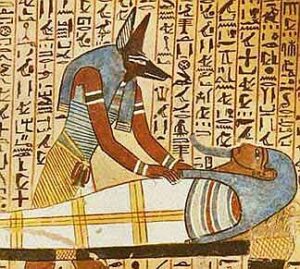
Anubis, is the jackal-headed, Egyptian god of death. He also presides
over the ritual of embalming. Myth states that he performed
this service on the great god Osiris. His Egyptian names were
Inpu and Wepwawet, which mean, “opener of the ways”.
It is believed that he led the souls of the dead into the west
to the Hall of Judgment.

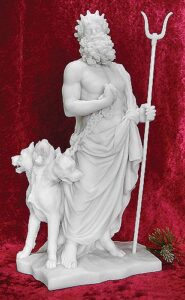
Hades, the Greek ruler of the Underworld, was the brother of the Olympian
god Zeus. Passage in Greek myth was processional. The Greek,
Hermes Psychopompos led the dead down into Hades. The ferryman,
Charon, took the dead across the infernal rivers. The infernal
rivers are the River Styx (river of hate), Achoron (river of
woe), Lethe (river of forgetfulness), Cocytos (river of wailing)
and the Phlegthon (river of fire). Traveling these rivers represented
leaving each of the ill feelings behind you, a purifying before
entering the afterlife.

A great many myths surrounding the dead come from Celtic cultures.
One transformation theme, stemming from Celtic belief, is that
of turning into a bird upon one’s death. The raven is a strong
example here.


Hel

Warriors of Northern Europe who died in battle might go to the god Odin’s
Great Hall of Valhalla. The goddess Freya received slain warriors
as well as the souls of women. Those dying of age, illness or
accident went to Hel, overseen by the God Loki’s daughter, also
named Hel (not to be confused with the Christian “Hell”).
Those who were chosen to die in battle were done so on Odin’s
behalf by the Valkyries. The name Valkyrie means “chooser
of the slain”. The female spirits went to the battlefields
and claimed the slain, bringing them back to Valhalla.

In Ireland, Badb, “the boiling one”, presides over the
great cauldron. The great cauldron is, in myth and modern pagan
belief, a place to which all life goes upon death and from which
it waits to be reborn.

Scottish lore provides that “willing” a dying loved one to
live, traps their spirit and prevents them from passing over,
thereby prolonging their suffering. The author and poet Thomas
Campbell wrote “to live in the hearts we leave behind is
not to die”.

Loved ones’ earthly forms may leave us but within our hearts
and memories their spirits live on. The common denominator in
most myths associated with death is that their is always a “higher
being” to welcome and guide you into the afterlife – but
that is just a pagan’s perspective.


Source: http://tinyurl.com/y9yhtk7

The Crone Calls

A Chant by
Banshee ShadowWolf,
Circle of Wondrous Stories

I can hear
the old crone call
in the dark still nights of fall.
Gaze upon her ancient face,
feel the winter’s cold embrace.

Walk across
the barren land,
Take ahold her icy hand.
Walk along through snowdrifts deep,
All the earth appears asleep.

This is
not a time to mourn,
All the dead shall be reborn.
Winter’s winds will lose their might
Thawed with the return of life.

As the seasons
move ahead,
Grandma Spider spins her thread.
So, again the light of day,
allows the night to have its way.

I can hear
the old crone call
In the dark, still nights of fall.
Gaze upon her ancient face—
Feel the winter’s cold embrace.

Source:
http://tinyurl.com/yz8do2m

Second Sight

by Nancy Coker

We are so dominated by our sense of sight that seeing-eye words
have crept into our very language: our opinion is “our
point of view”; if we reverse our opinion, we change the
way we “look at things”; when we understand we say,
“I see.” We experience many different ways of seeing
besides ordinary physical eyesight: prophetic visions; visions
of saints and mystics, shamans and healers — some of whom say
they can see the illness; visions one has in dream states; visions
of life review said to be seen by the dying; “eyeless vision”
by which Russian experimenters read with their fingertips; sightings
of witches; sightings of angels, nature sprites, fairies, elves,
leprechauns, elementals, UFOs, and ghosts; ecstatic trances
of those on vision quests; the perceptions of visionary artists,
and of those on psychedelics and hallucinogens. Major religions
were heralded with visions — and each year there are hundreds
of reported sightings of Mother Mary in the West and Kwan Yin
in the East. But are all these visions equally significant?
Is an accurate tarot reading in the same category as a mystic’s
vision of God?

Our sense of sight is extremely compelling — seeing is believing.
But perhaps we have two eyes to remind us there is always more
than one way to look at things — after all, it looks as though
the sun moves round the earth. The very fact that our minds
can override our physical sight reminds us that we exist on
many planes, and that the ability to see or understand is part
of our nature on each of those planes.

Spiritual vision, rooted in our spiritual nature, is the most comprehensive;
it sheds light in a way that illumines and transforms our whole
landscape. Mental vision, rooted in our mind, is more restricted
and is expressed as comprehension. Physical vision, rooted in
our astral nature, is the most limited.

We tend to act, however, as if truth were perceived with our physical
eyes; as if since we see it a certain way, it truly is that
way, instead of being only the aspect of truth that we perceive.
We shape our world according to the shape of our physical apparatus
— for example, if we had the “eyes” of a jellyfish,
we would not have enough cells to form an image and all we could
detect would be motion. For the jellyfish, anything motionless
blends into everything else and literally does not exist till
it moves.

It was once thought that our visual system recreated a tiny upside
down replica of what is in front of us, and that the brain corrected
the size and reversed the image. Now it is known that eyesight
is really a network of events with different neurons sensitive
to certain stimuli firing in response only to those specific
stimuli. We have four parallel systems concerned with different
attributes of vision: one for color, one for motion, and two
for form. The neurons are so scattered that scientists don’t
understand how the brain can organize visual patterns to make
a coherent picture. “Experimentalists have not found one
particular region in the brain where all the information needed
for visual awareness appears to come together.” That’s
like saying that the process of seeing resembles the memory
in a dot matrix printer thousands of little impulses with no
paper to print on.

Understanding that our physical systems for seeing are complex, but limited
to a small range of the spectrum and rather deceptive, we certainly
cannot assume that 20/20 vision on the outer, material plane
translates to 20/20 on the inner planes. The general category
of inner vision or second sight is called clairvoyance (French
for clear seeing). But what are we looking at and what are we
seeing with?

Just as the visible spectrum has intricate and infinite gradations,
so the invisible spheres have gradations from the lower astral
to the higher. There are many gradations and layers in the astral,
just as in a fog bank. Imagine standing on a hillside watching
the fog roll in. At its highest, closest to the sun it is bright,
warm, clear, ethereal. Where the fog is closest to the earth
it is darker, cooler, harder to see through like the lower regions
of the astral. Spiritual sight is like getting above the fog
— surfacing above all the confusion of the lower realms and
getting a breathtaking view of the whole. Astral sight is like
snatching glimpses through the fog. The astral is an energy
field that surrounds and permeates our earth. As the lowest
intermediate plane between the physical and spiritual it is
probably the basis for our stories of hell and purgatory.

Theosophical teachings state that the astral light is so plastic and sensitive
that we constantly impress it with our thoughts and actions;
it in turn impresses us, reflecting back everything — thoughts,
actions, feelings. It is described as containing images of all
that has ever happened, as well as pictures of future events
whose causes are already sufficiently well defined. The transmission
of vibrations through it is said to be practically instantaneous
— faster than light or electricity.

Every thought we have takes the shape we give it and lives on in the
astral — which is why clairvoyants can see what has happened
to us. All our thoughts come through the astral, attracted to
us sympathetically; strong feelings are like huge thought magnets.
Impressions are made on various planes depending on intensity
and duration. Some actions influence many different levels and
planes so much that untrained seers would not be likely to see
the whole picture: they would penetrate only into whatever planes
had a vibration similar to their own. Adding to the confusion,
everything in the astral light is said to be reversed. How could
anyone know, when peering into it (perhaps to try to look into
the future), if one were reading hopes and wishes, or actual
causes that had been set in motion?

Still, the experience of seeing into any of the invisible planes can
be so intense that it feels as if a fundamental truth has suddenly
been revealed. Some are convinced that God has spoken or sent
a message, or even the Devil — it feels so extraordinary that
it seems it must be completely spiritual (or conversely totally
demonic). But the astral light is also a plane of existence
for entities that have faculties and forms of their own which
are not at all like ours. Elementals that have to do with the
forces of nature exist there. They have no recognizable form
— the seer gives them shape and structure that perhaps is why
we sometimes see entities (the devil with horns and a tail)
that look exactly as we expected them to. Additionally, all
beings that die pass through the astral. When our physical body
dies and drops away, we are not left without a vehicle. Our
desire, vital, mental, and spiritual components remain for a
time on the astral plane, still attracted to the body they once
enlivened, and are sometimes even spotted in graveyards as ghosts
or spooks.

At this stage of our evolution, the astral body of a human being
interpenetrates the physical body — the teachings say that
every sense originates in the astral or has an astral counterpart
that is the actual center of sense perception. We see with astral
centers that rely on the eyes for sense impressions. From this
perspective our physical apparatus acts as a veil to limit our
senses, protecting us from too much input that could be confusing
or even harmful. The nightly news reminds us regularly of how
we keep failing to live successfully with the capacities we
already have. Imagine if your local gang members possessed the
ability to accurately read your mind or foretell your future?
It takes a strong moral and ethical nature to handle such responsibility
that tends to destabilize those who are not mentally and morally
ready to handle it.

Seeing in the astral light is not done through the spirit or mind,
but through the senses. In the same way that we must not believe
everything we “see” physically, we would do well to
reserve judgment on the seeming truth of what we see in the
astral. Spiritual clairvoyance, on the other hand, describes
a much larger illumination. It is sometimes depicted as sudden
enlightenment or a flash of cosmic consciousness that brings
a whole new perspective and deep inner understanding. In the
same way that we take in more with a glance than we ever fully
notice, true inner sight (insight) can comprehend more in a
glance than is possible for all the five senses put together.
Like a grand Ah ha! experience it brings together all the issues
and questions in a new way. Like Archimedes jumping into the
bathtub — Eureka! — we suddenly understand! This Ah ha! experience
is an immediate, direct perception which is transformative —
everything is seen differently in the light of greater illumination.
The essence of theosophy is this direct perception, this experience
of understanding, wholeness, and divine wisdom we encounter
with our hearts’ vision. This kind of inner vision, insight,
or second sight takes place beyond the reach of senses or of
the logical, reasoning mind that wants to define and separate.
We can’t think our way to inner vision; it takes place outside
of space and time, like a fifth dimension.


But mind does have an important role. If it is agitated or too
narrowly focused it will block the vision. In general, limited
thinking leads to limited vision, and the most limited thinking
is that which revolves around ourselves. Like the fog bank,
our self-centered thoughts hang around the lower planes. Our
thoughts that can escape the bonds of self, naturally ascend
to purer realms. Spiritual vision is too subtle for our physical
senses and does not register on them, while the lower reaches
of the astral light do.

How can we tell the difference? One guideline may be that the more
universal and impersonal the content, the more spiritual the
source. The more personal, specific, and exclusive, the more
likely it is we are seeing into the lower aspects of the astral
light. We live in an age where channeling, automatic writing,
and psychic readings are all the rage. No doubt some are outright
frauds, but many are sincere searchers fascinated by the glamour
of their new-found powers. But who or what are these seekers
seeking, and who or what are they in touch with — their higher
self, the minds of others, the astral light, phantoms of the
dead, or…?

Learning to discriminate takes understanding of some basic principles,
patience and practice. We benefit from discovering new ways
of seeing things — real education may be learning to see the
same landscape with new eyes. With an open heart and a discerning
mind we need not be afraid to always walk with our eyes wide
open.

Reprinted
from Sunrise Magazine, Jun/July 1993.
Copyright © 1993 by Theosophical University Press

Goddess Ceridwen – Birth and Death

I
give you life
I give you death
it is all one
You travel the spiral path
the eternal path
that is existence
ever becoming
ever growing
ever changing
Nothing dies that is not reborn
nothing is born that does not die


When you come to me
I welcome you home
then I take you into my womb
my cauldron of transformation
where you are stirred and sifted
blended and boiled
melted and mashed
reconstituted then recycled
You always come back to me
You always go forth renewed
Death and Rebirth are but points of transition
along the Eternal Path.

~~ Source Unknown ~~

Shadow Energies – Prey Animal Aspecting

by Wildspeak

What is a Shadow Energy?

The shadow energy (more familiarly known as ‘totem’) is an animal
that challenges us somehow.

We fear it, or we dislike it. We experience an irrational feeling
of distaste or revulsion towards it. It is an animal that we
might kill, or avoid, or turn off when we see it on television,
and it is an animal that can feature in our nightmares or that
may even have attacked us in the past.

It is thought that we fear these animals because they teach us
the lessons that we don’t want to learn, because we fear what
we might lose in the process and even what we may gain. We may
fear what the animal may tell us about ourselves, often it forces
us to confront harsh truths about ourselves.

What we dislike most about the animal, may be what we dislike most
in ourselves, or it might represent something that happened
to us, or is happening to us, that feels harmful and unpleasant.
In extreme cases, we can develop phobias of these animals. Or
worse, we may begin to kill them en masse if we get the opportunity.

It is called a ‘shadow’ energy, because like many aspects of ourselves
that we don’t like, it is often marginalised and ignored. Even
spiritual people have a tough time confronting and working with
their shadow energies.

It is possible to have more than one shadow energy, and it is possible
for them to change over time. Almost everyone has them. In some
cases it’s easier to know which animals we have problems with
than others, because they might be animals we confront regularly
like spiders or fleas. Sometimes it’s more difficult, it’s an
animal that’s easy to avoid because it might only be at the
zoo, or in books.

Some common shadow energies:

  • – Ant
    – Flea
    – Bee
    – Wasp
    – Mosquito
    – Fly
    – Tick
    – Spider
    – Snake
    – Horse
    – Raven / Crow
    – Wolf
    – Hyena
    – Cuckoo

There are of course a lot of others! You might think of fears and
dislikes your friends have had in the past, or fears and dislikes
you have had.

Ask yourself the question:

If you fear ‘spiders’, you need to be very exact. Do you fear ALL
spiders? Or the poisonous ones? Or the fast ones? Or the big
tarantula ones? Do you fear all wasps? Even the ones you’ve
never seen? Why? What about cuckoos? Do you hate them because
they push eggs out of the nest? Or because you think they’re
ugly?

Ask yourself the relevant questions, WHY do you fear or dislike
the animal. Start simple. Write down some answers to these questions
and you can start to narrow down the nature of your fear:

What kind of ‘animal’ is it?

What does it look like?

How does it act?

How does it move?

Can it hurt me?

Do I fear / hate it as much as other animals that can hurt me more
or in the same way?

Powerful Medicine

Needless to say, one of the most powerful exercises we can do, is confront
our shadow aspects and work with them consciously and subconsciously
to create a working relationship with them. This is a spiritual
process, often initiated through meditation and visualisation
of the animal itself, and can force us to light a candle to
the shadows of ourselves that we deny, or suppress, or ignore.

Shadow energies have powerful medicine, if we imagine that we are trying
to always improve ourselves and get closer to the spirit and
wholeness, the shadow animal can give us very direct paths to
this. Shadow energies are not gentle, they do not coddle us,
and sometimes working with them can involve tears, terror, and
even pain if the animal has attacked us in the past, but they
do show us very direct paths to the spirit, and to home truths
that once confronted, often show that the animal itself is not
half as fearful as we thought it was!

For example, venomous animals often force us to confront that we
too are capable of brutal, poisonous acts to get what we want.
There’s no point denying it, and spiders and snakes (and other
venomous animals) tell us that we need to not only confront
this truth, but embrace it, and eventually learn how to love
and understand it. Through this love and understanding, we reach
a new respect of ourselves and the animal through spiritual
work.

Sometimes shadow energies will even become your primary ‘totem’, or one
of your more significant guides. If you are open and honest
with the animal and with yourself, you may even develop a powerful
ally who can help you in otherworlds, ritual and spellwork.
You will also become well-equipped to help others face their
own fears and dislikes of the same animal, because you will
often know what you had to go through to get to a place of understanding.

Taking your time.

Some people like fast results in their spirituality, the idea of
a long and protracted journey of hard work with little results
can be frustrating to say the least. But with shadow animals
it is important to understand that reconciling your shadow self,
even aspects of your shadow self, with your conscious self can
be a difficult and ongoing process.

Of course the process might also be very fast! You might have a
lightning bolt of realisation and suddenly go ‘yes! I do hate
that about myself, and I fear this, and I’m going to do *this*
to fix it, why did I never figure that out before?’ But most
of the time this process is slow and ongoing, and entirely worth
it and rewarding in the end.

Don’t force the process, sometimes you will not be ready at all, and
you will know when it happens. Be patient with yourself. Respect
and understand yourself and your spiritual journey as you are
learning to respect and understand your shadow energies.

Prey energy is everywhere. Almost all animals have adaptations that
they have assimilated that assist them as ‘prey’ animals, even
as they have adaptations that help them to predate on plants
or other animals. There is no one animal that is solely a ‘prey’
animal, or solely a ‘predator.’ All animals are at risk of being
predated upon (some much more than others) and all animals are
predators to a degree, whether they hunt ‘grass’ or ‘algae,’
or catch and kill deer for breakfast. The same goes for humans!

Through my own observations of the online and offline pagan communities
today; many people seem to have totems or guides that are carnivorous
or omnivorous. Herbivorous animals tend to be left by the wayside,
with a few exceptions like horse, rabbit and deer. Herbivorous
animals are even outright disdained for being the weaker animals.
This potentially originated from a time when animal predator
energy was respected as being the stronger and more necessary
energy among hunters in hunter / gatherer societies. It’s certainly
been bolstered by the belief these days that many predatorial
animals (particularly apex or ‘top’ predators like tigers) are
charismatic and cool. And who can blame them? There’s a certain
showiness to having lynx as a totem, instead of harvest mouse
or sparrow.

Aspecting with animals that are more classically thought of as ‘prey’
animals (such as most herbivores) can help us to understand
how we can better protect ourselves from danger and predators.
It can help us to conserve energy and live efficiently, and
can also help us not to underestimate animals that are often
thought of as ‘prey.’ It allows us to access deep wells of power,
endurance and persistence which can complement ‘predator’ aspects
and aid us – I believe – in achieving a greater sense of wholeness
or balance.

Aspects
of the Prey Mentality and Adaptation

CAMOUFLAGE
– Developing colouring or patterning that is bland and matches
in with the landscape is a successful defense mechanism that
can be used to prevent any confrontation (it is also, on the
other hand, employed by some predators to aid their ability
to move closer to an animal).

From a prey perspective, avoiding confrontation conserves energy
and in turn helps us to better observe our surroundings without
being observed. We can use such techniques while journeying
in order to move more freely in some parts of the Otherworld,
and often we become better able to spot those who use camouflage
once we ourselves have tried it.

Likewise, camouflage can also be used to further enable our ability to
façade in the everyday, or perform the sort of mundane
shapeshifting that allows us to fit in with different groups
of people in order to best afford conflict that is unhealthy
or unhelpful without sacrificing the parts of our personality
that we wish to keep. In other words, we can learn how to change
ourselves to ‘fit in’ better, without becoming a doormat, or
losing a sense of who we are.

Animals to consider working with to specifically aspect camouflage:
pronghorn antelope, ibex, chameleon (as both prey and predator),
arctic hare, tawny frogmouth, Malaysian horned frog (and many
other frogs and toads as both prey / predator), sloth, flounder,
kangaroo, meerkat, many caterpillars / fish.

ALERTNESS
– Most prey animals cannot afford to sleep as much as many keystone
or apex predators, and predators in general. Animals that tend
to sleep the most, are those which hunt meat and need to feed
less often, or that are at less risk of being predated upon.
The animals that sleep the least; like the horse, do so because
they must protect themselves and their herd from other horses
and predators.

Remaining alert is the act of continuously and consistently giving something
your attention. It can be very handy for people who have projects
to complete, those who have exams they wish to study for with
consistency, and those who wish to simply foster a greater sense
of ‘awakeness’ into their lives (remember to balance this with
rest, because we’re not horses). In short bursts, aspecting
with prey alertness can allow us to scan situations with greater
perception, and apply ourselves with greater concentration to
immediate projects.

Working specifically with animal alertness can also help us to distinguish
the difference between useless anxiety, and useful ‘stress’
or awakeness. This can be very handful in contemporary times,
where instances of anxiety and those with anxiety disorders
are growing. Learning to differentiate between healthy stress;
and worry that impedes us from everyday tasks can make the difference
between health and ill-health.

Some animals to consider working with to specifically aspect alertness:
horse, donkey, giraffe, elephant, sheep, kangaroo, cow and goat.

DEFENSE vs. OFFENSE
– Many animals when acting as prey, are very fast movers, and
adept at running or dodging, or they use camouflage and simply
‘avoid’ confrontation. Aspecting with defensive strategy, instead
of offensive strategy, can allow us to better conserve our energy
and teach us to see when it is beneficial to step back from
confrontation.

In everyday life, this can be made manifest in the act of withdrawing
from a situation before a confrontation can even take place.
It can appear in having the sense to not walk down a dark alleyway,
or in simply avoiding people who feel dangerous.

While confrontation is certainly necessary at some points in our life,
it is not always necessary. Aspecting with prey animals to learn
when to avoid, walk away or recognise when something is not
worth your time, will enable you to conserve energy for healthier
or more realistic goals.

Animals to consider working with to specifically aspect defensive mechanisms: almost all deer, antelope, rock wallaby, rabbit, bat, sparrow
/ swallow, butterfly, dragonfly and mouse.

GROW UP – Some newborn prey animals are precocial, meaning that they’re able to walk and run within the first few hours of being born.
This is important, because they are most at risk (along with
the sick and old) of being predated upon.

Precocial behaviour teaches us how to learn something quickly, particularly
if an old habit or negative behaviour is literally causing us
to be predated upon by ourself (such as our own self-hatred),
or by others.

One thing to beware of when aspecting with precocial animals, is
that this sort of aspecting should not be done over the long-term
as it can be very draining. It is most useful when there is
a particular block that you are up against and cannot seem to
get past. It is not for learning lessons over a period of time.
Aspecting with precocial behaviour can lead to a burn out of
energy. Try it in small doses if you’re not sure how you’ll
go with this sort of prey aspecting, you should notice some
success within about a day or so of aspecting with this specific
type energy if it is working well.

Animals to consider aspecting with for precocial qualities are: many
birds are precocial, like malleefowl (which are superprecocial,
and have full wing feathers upon birth), scrubfowl, brush-turkey,
chicken, guinea pig, hare and many hoofed animals.

IMMEDIACY
– Prey animals must react on instinct immediately (as must predators,
but we’re talking from a prey perspective here); they cannot
afford to question a fear or startle response. Worse, they can
definitely not afford to ignore it. Responding with immediacy
can be the difference between getting away from a pride of lions,
or becoming their dinner.

Working with prey animal immediacy can teach us not to ‘hum’ and ‘hah’
over important decisions; particularly ones pertaining to our
health and our quality of life. It can be very scary to make
important but necessary medical decisions, or decisions regarding
promotions at work, or even decisions within a relationship
(whether to cut it off, have a break, or keep going at it).

Aspecting with immediacy teaches one how to see through to the heart of
the matter and trust one’s instincts. This sort of aspecting
is particularly helpful for people who have damaged instincts
due to abuse, who need to learn how to reconnect with their
own inner trust and truths.

Animals to consider connecting with for immediacy are: most species
of hoofed animal like horse and deer, bat, mouse, insects (like
fly),

STRENGTH IN NUMBERS
– The most popular prey animals, and many of the
most successful (like the rabbit) live communally.. I don’t
think it is any coincidence that some of the bigger ‘prey’ animals
that live in numbers, like the elephant and cape buffalo, are
considered some of the most dangerous animals in the wild; and
the bison is sometimes considered more dangerous than the wolf
in America. When you have the strength of your herd or pack
behind you, you become a force to be reckoned with!

There is of course the idea that if you surround yourself by others,
you are less likely to be ‘singled out.’ Some people like being
singled out, or standing out in a crowd, but just as many people
don’t enjoy this sort of attention and prefer to blend in. Prey
aspecting with communal animals can help you to ‘blend in’ more
effectively while you are still figuring out where you stand
in the crowd.

Additionally, when you surround yourself by others in a community, you lend
your strength to them, but they also lend their strength to
you. It can be a very empowering experience to be in an offline
or online community of people who have similar beliefs to yours,
who will help you and protect you in a heartbeat. Likewise protecting
someone else with a similar cause to yours can remind us of
our inter-relationships with others and how important they are.

Animals to aspect with for a strong sense of community are: elephant,
cape buffalo, bison, hippopotamus, horse, many hooved animals
like deer, rabbit, hare, kangaroo, wallaby, parrots like the
galah, black cockatoo, budgerigah and lorikeet, insects like
the bee and ant.

In Conclusion

This is just a peek into the ways that you can consider working with
‘prey’ animals, or prey animal characteristics, in order to
better your own connection with nature, others, and yourself.
As you work more extensively with animals that you may think
of as prey animals, you will see that they carry very strong
characteristics of predation as well.

No animal exists solely in the realm of prey or predator; but sometimes
singling our characteristics of prey-type adaptations, and predation-based
ones can help you to aspect with those characteristics and develop
closer relationships to animals with such characteristics.


Source: http://tinyurl.com/ybu4o77

click here to warp to part two